Four days into my seven-day Bali holiday and I’m ready to leave my suite to do something active, other than the gym. At 8.00 am each morning, Sankara Suites and Villa in Ubud offers a complimentary guided walk through a local village.
My guide, Yorgi, tells me that today we’ll do one of two village walks on offer, starting with a 10-minute drive to the starting point. I’m the only one taking up the opportunity today, so it’s like having my own personal guide!
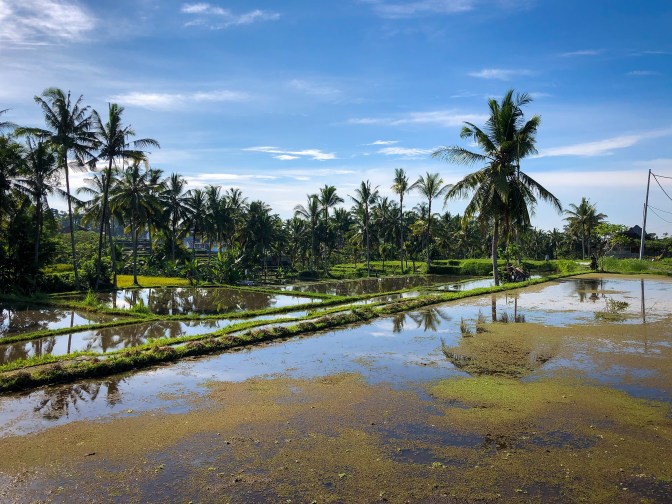
Dropped off by the resort driver, we step off the road and start walking inland. Pausing for scooters, we navigate a cobbled walkway down to a small Hindu temple, that Yorgi explains is used by all the farmers in the area to provide offerings to the Hindu God, Lakshmi, the goddess of prosperity. As a local collective, they will hold ceremonies at the temple a couple of times a year, and at other times, they’ll individually make personal offerings.
In Bali, rice is planted every six months. The hard work is at the beginning of the season, during preparing and planting. Machinery now helps to prepare the soil, but the planting is still done by hand. After that, they carefully monitor the paddies each day to ensure the plants have plenty of water.


At this time of year, Yorgi explains, it is the end of one harvest and the beginning of the next. She points out empty paddy fields ready for new seedlings, and the waiting seedlings already planted in small sheltered areas next to the fields. Once they’re about 5 centimetres in height, they’ll be planted in the prepared plots.
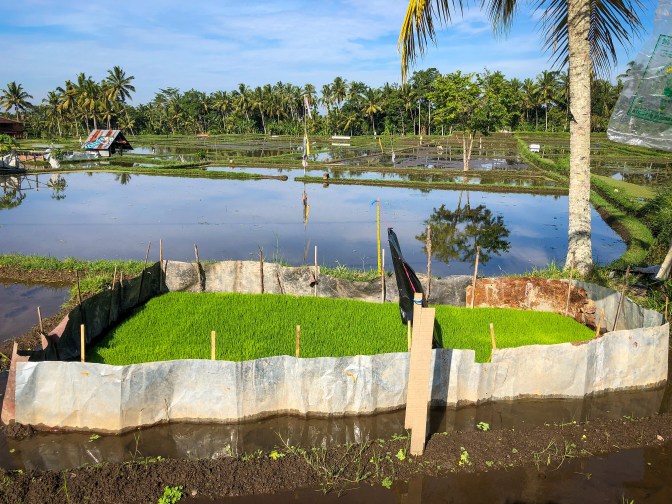
In this area, farmers grow four varieties of rice: white, red, black, and sticky. Red rice is good for feeding the babies, she explains. Black rice is used in puddings and cakes, while white and sticky rice are used in cooking. None of it is exported, she says. It’s all either used by the farming families or sold at market to local resorts and restaurants.
Further along, she points to small structures in the fields. They’re built for the farmers to shelter in during the day and the houses we pass along the roadside are mostly tourist villas. No Balinese live alongside their paddy fields, she says. All will live in the surrounding villages and travel to and from the fields each day to tend their crops.
As we negotiate the busy road, stepping off every couple of minutes to let scooters whiz past, I see birds everywhere – ducks swimming across prepared paddies, herons clustering around farmers rotary-hoeing, and small finches diving in and out of browning crops.
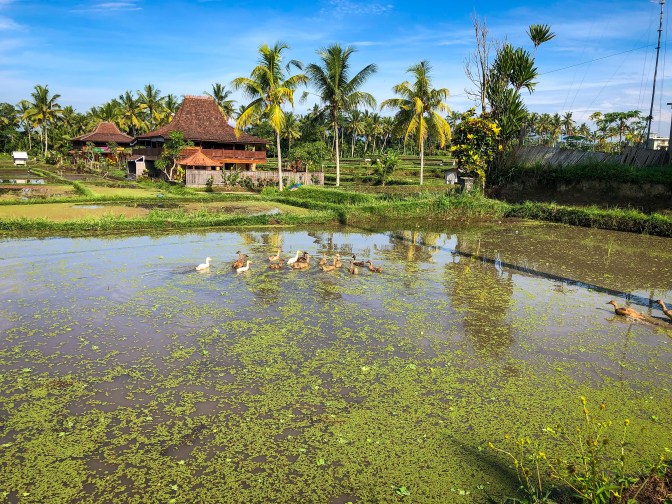
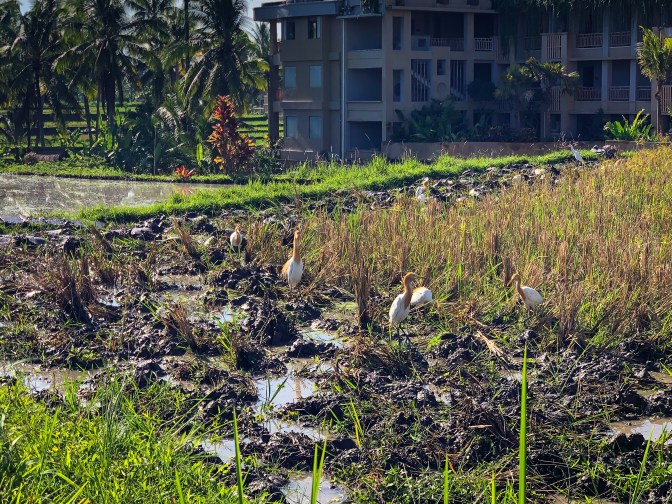
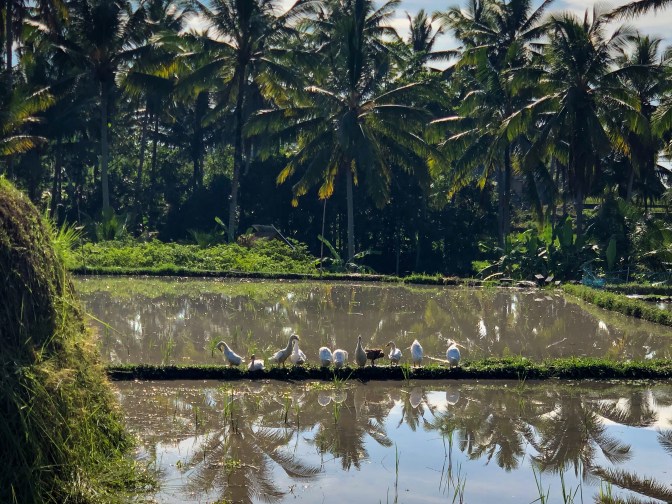
The ducks and herons help the farmers, she points out. They clear the prepared paddies of small pests and insects, but the finches are a big problem. They swarm in large murmurations in the early hours of the morning and eat the growing rice seed pods. It’s not unusual to hear loud drumming and shouting around 3 or 4 am as farmers attempt to scare the swarms away. The rest of the time, a scarecrow does the job.
As we reach the main road, I realise we’re making our way back to the resort on foot. So far we’ve trodden even ground, but as we begin climbing a small hill I feel sweat trickling down my back and I stop to grab a water bottle from my backpack. We briefly shelter from the sun and talk a little about where home is for each of us, and how farming is very different in New Zealand.
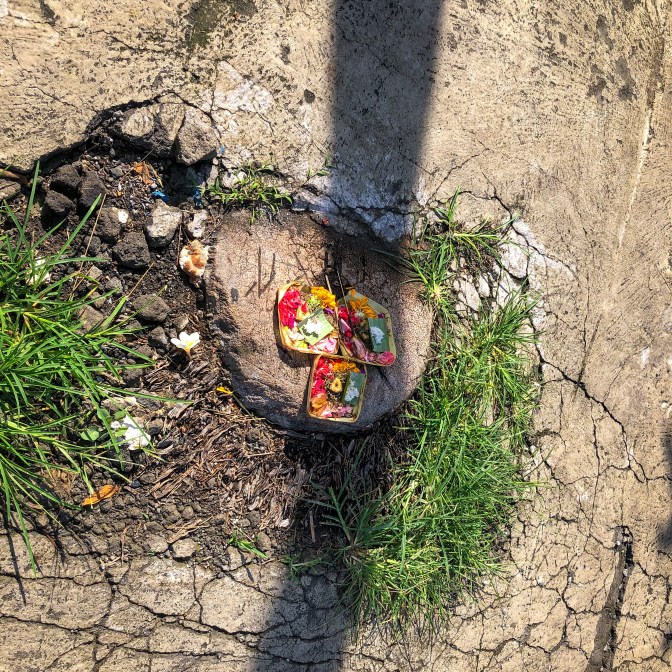
Rested and replenished, Yorgi now guides me through the local village, pointing out family homes and small Hindu offerings on gateposts and in front of driveways. The tiny rice offerings on the driveways, she explains, are intended to ask the ants, cockroaches, rats, mice, and other pests not to invade the home.
Yorgi names the other crops and fruiting trees along the roadside: sweet potato, jackfruit, papaya, and banana. Of course, they’re familiar and I share the Fijian and Maori names for them, and what I know about them. Just as in Fiji, they grow different varieties of banana and, just as the Indo-Fijians do, the Balinese also curry the white, unripened jackfruit.
At a crossroads in the centre of the village, she points to a sign with the heron symbol. This is the home of the herons I saw in the fields, she says. This village protects them. We walk past local dogs standing or lounging in front of their master’s gates. I watch fascinated as cars and scooters steer around them on narrow tar-sealed roads.
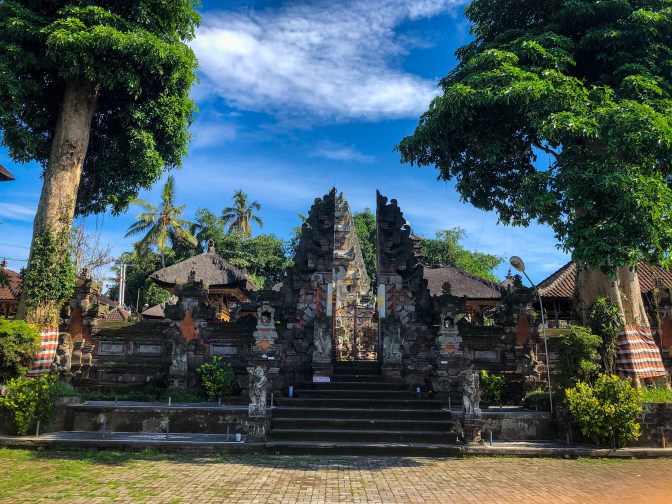
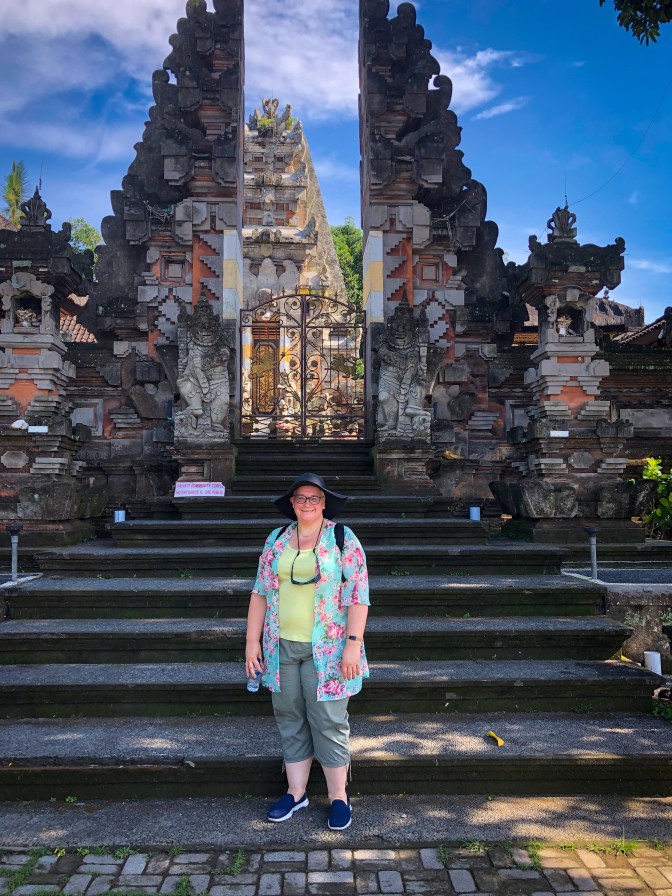
As we step up to a large Hindu temple complex, Yorgi explains that here the whole village will gather for annual festivals and ceremonies. She offers to take my photo at its steps. It is only then that I notice our driver is waiting with the van to take us back to the resort. I’m so relieved to be stepping into its air-conditioned interior that I groan. They both smile back at me and offer me more water.
I look at my watch and realise I’d been so fascinated that I hadn’t noticed we’d walked for about 45 minutes. Back at the resort, I hand Yorgi a small tip and thank her for the experience.

 sidalscapes
Very interesting. A personal guide is so helpful, like we had that personal tour in Scotland. You can ask as many questions as you want. Interesting that this is local farming for a local community, including tourism. And the use of the different coloured rice – I had only heard of black and, of course white
LikeLike